

 By
By 
After a five-year legal battle that tested not just the courts but the national patience threshold, Econet Wireless Zimbabwe finally launched on 10 July 1998. Nearly 28 years on, its relationship with the authorities has matured—if one can call a decades-long standoff “maturity.”
By Toneo Toneo
From the beginning, Econet’s existence under the ZANU–PF government has resembled a reluctant marriage: legally binding, strategically necessary, but rarely affectionate. The lone moment of early goodwill came courtesy of then Vice President Joshua Mqabuko Nkomo, who ensured the company’s entry into a market already occupied by the state’s own NetOne—freshly carved out of the Post and Telecommunications Corporation.
Open Conflict
Then came the Supa Mandiwanzira era, which briefly abandoned subtlety altogether.
What followed was not open conflict, but something arguably more enduring: a slow-burning, policy-driven chess match. No dramatic explosions, just carefully calculated moves—regulations here, compliance there—each side probing the other without ever quite declaring war.
Just a steady stream of regulatory side-eyes, policy ambushes, and the occasional bureaucratic chess move. Think less “war” and more “passive-aggressive emails,” except at national scale.
Punitive $137.5 million licence.
When the government was ready to go for the 2013 elections, Econet Wireless Zimbabwe “fat Wallet” had to be pressed, a new law was passed demanding that all mobile network operators would now pay a 10 year license of of whopping $135 million.
This fee although it was targeted to the sector, Econet paid the huge chunk as a lumpsum.
Government o raised the operating license fees for mobile network and fixed telephone operators, the licenses were issued under a new Converged Licensing Framework.
Econet however settled off US$60 million in interconnection fees which it was owed by NetOne and TelOne
Controversial Infrastructure Sharing Policy
His infrastructure-sharing policy—presented as a noble push for efficiency—landed more like a compulsory group project where one student had done all the work. Econet, unsurprisingly, was that student.
Rivals such as Telecel Zimbabwe were expected to benefit, while Econet was expected to cooperate enthusiastically. It did not. Still, in principle, the policy wasn’t entirely misguided; globally, infrastructure sharing is sound economics.
To be fair, on paper it sounded noble—sharing is caring, after all. But Econet wasn’t thrilled about being the generous sibling while Telecel Zimbabwe and NetOne showed up with comparatively lighter contributions to the potluck.
Regulator Postal and Telecommunications Regulatory Authority of Zimbabwe (POTRAZ), under Gift Machengete, eventually stepped in with its own infrastructure-sharing solutions—arguably one of the rare moments where everyone agreed on something, or at least stopped arguing long enough to build towers in remote areas.
Ecocash Of Phantom Money and Economic Sabotage
To its credit, the regulator—Postal and Telecommunications Regulatory Authority of Zimbabwe under Gift Machengete—eventually introduced its own sharing initiatives. These quietly extended network access to underserved areas, proving that even contentious ideas can yield practical outcomes when handled with a lighter touch.
Meanwhile, Econet’s mobile money arm, EcoCash, took its turn as the economy’s favourite scapegoat. Under former central bank governor Gideon Gono, it was accused of enabling a parallel cash market—prompting regulatory interventions that effectively shut down key agent functions.
Years later, John Mangudya revived the tradition with warnings of “phantom cash,” a concept that sounded alarming enough to dominate headlines, though tangible evidence remained notably elusive. The hostility, however, was entirely real.
The accusations came, the headlines followed, and then… well, everyone moved on, still slightly confused, at least, We all googled Phantom money!
Minister Shamu and the Tariff War
The 2009 tariff saga offered another familiar pattern. Then ICT Minister Webster Shamu approved foreign currency pricing that made phone calls feel like premium services—up to $0.29 per minute. Public backlash was swift and the big brand Econet was easily targeted for implementing the ceiling tariffs, unforgiving, ultimately forcing the industry into per-second billing. In Zimbabwe, it seems, progress occasionally arrives disguised as outrage.
The silver lining? It forced operators to adopt per-second billing—proof that sometimes public outrage does, in fact, come with benefits, thanks to Potraz, it came out of its shells and solved a pertinent problem.
And then, unexpectedly, the script changed.
Data Must Fall Campaign
With the minister Muswere and national uproar on data, Zimbabweans engaged national online data protests pushing Hastag #DataMustFall, it was easy targeting Econet for leading the with hiher tariffs.
MiSA wrote :
Affordable and reasonable fees will allow for increased access to the Internet and enable the majority of citizens to access, share and spread information on COVID-19 which will go a long in assisting the government’s efforts to curb the spread of the virus in the country.
The Engagement and Thawing
However in the past 2 years, i have been closely monitoring the same Econet – government relations and I can attest that there is a serious policy shift, a deliberate handshake, and indeed a peace pipe has been smoked, not sure who rolled the cigar, with the current minister of ICT Postal and courier Services Tatenda Mavetera , showing real intent to let bygones pass and be intentional towards mutually working together.
Over the past two years, under ICT Minister Tatenda Mavetera, the long-standing frost between government and Econet has begun to thaw. Not through grand declarations, but through something far rarer: visible, deliberate engagement.
For the first time in recent memory, a minister visited Econet’s operations not to interrogate, but to understand. In a sector conditioned to expect friction, this was nothing short of radical.
The ICT minister actually visiting Econet Wireless Zimbabwe, touring and appreciating the work and progress they are undertaking and discussing serious symbiotic relations. This move has never been done by any of the past 5 ministers from Nelson Chamisa, Webster Shamu, Supa Mandiwanzira, Kazembe Kazembe and JenFan Muswere.
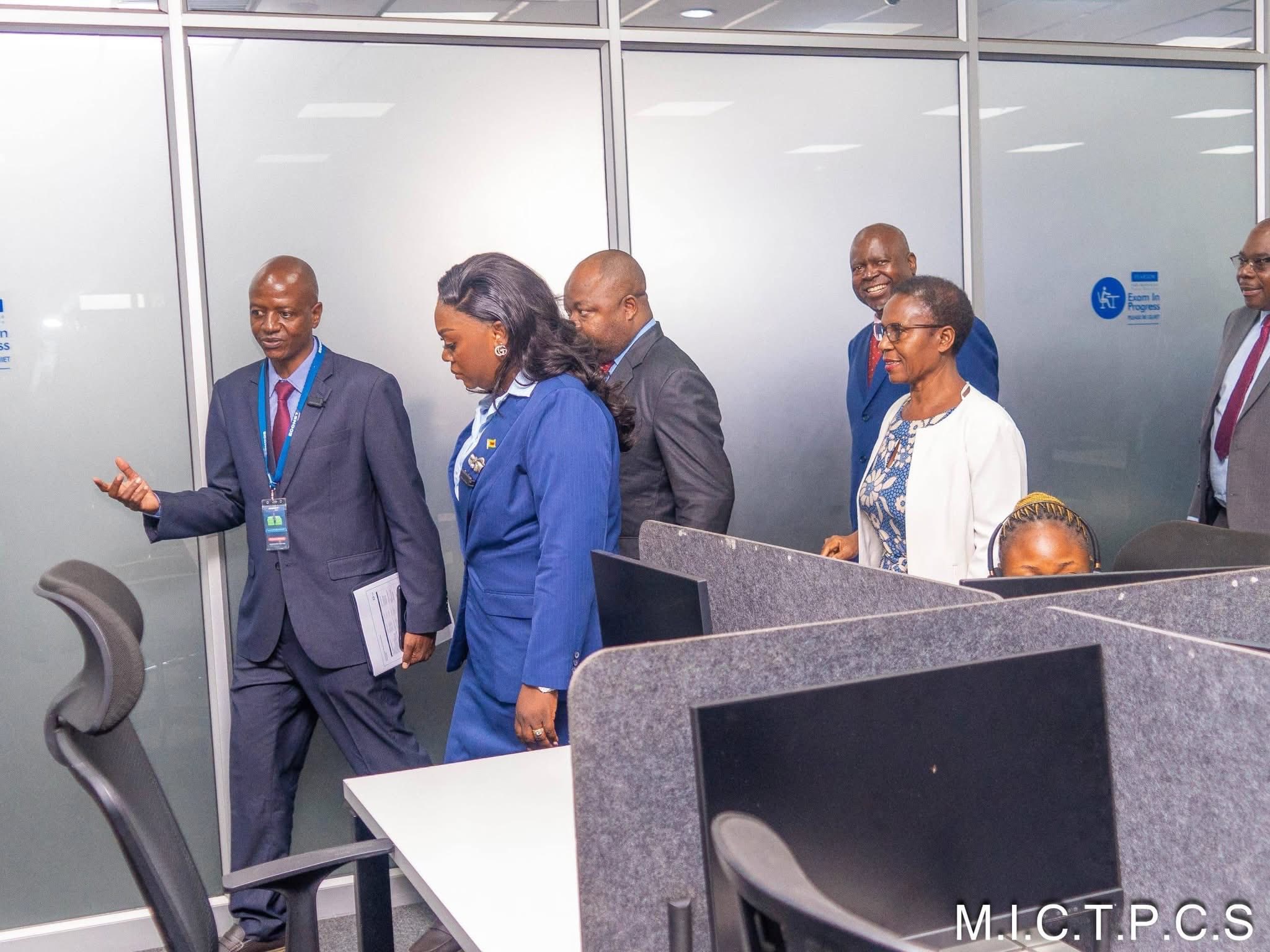
More telling still was the sight of Econet CEO Douglas Mboweni participating in a government event, which was a headliner, a government-led AI policy event—going as far as delivering an opening prayer. In another context, this might pass unnoticed. Here, it felt symbolic: it was a genuine act of faith, a quiet acknowledgment that coexistence might finally be giving way to cooperation, indeed it was in good faith
The recent Econet AI launch which was graced by the minister of ICT , Hon Mavetera, her Deputy Minister Dingimuzi Phuti, Permanent Secretary Beaullah Chirume and Chief Director Prince confirmed that the chemistry has warmed up very well, into a “serious relationship”, and the two key stakeholders in the tech sector are going on very well, finding each other for the best interest of the country.

Recent industry gatherings reinforce this shift, last week in Bulawayo at the Digital Economy Conference, figures such as having the Deputy CEO of Econet Roy Chimanikire , NetOne CEO Raphael Mushanawani, Liquid MD Loretta Songola, Dandemutande CEO Never Ncube, TelOne CEO Lawrence Nkala, Powertel MD Wilfred Nyagwade and Potraz D Gift Machengete shared the same platform—an arrangement that, until recently, would have seemed improbable. In Zimbabwe’s telecom sector, proximity has historically been measured in regulatory distance, not physical seating.
What was more deliberate was the tour by the president of Zimbabwe and the Botswana to the Econet stand during the ZITF, this was no coincidence but well planned gesture, the minister herself made sure the president visited the top performing ICT entity, allowed the deputy CEO Roy Chimakire to take minutes on the stand while touring their key services to the heads of state, this was the first time ever of such a gesture.

If this détente holds, it may even draw back Strive Masiyiwa into more visible local engagement. With his investments spanning the continent, Zimbabwe has long appeared more symbolic than strategic. That, too, may be changing; if persuaded, we are set to another ground-breaking warming up.
For now, credit belongs to the energetic Minister Mavetera, whose approach marks a clear departure from the past, her approach marks a clear departure from the past three decades. Should this newfound cooperation endure, the sector may finally shift its focus from surviving policy turbulence to actually growing.
She has been deliberate and very intentional in her engaging; Zimbabwe’s telecom history advises caution.
Still, after nearly three decades of friction, even a functional working relationship feels revolutionary.
And in this sector, that may be the most disruptive innovation of all.
If you understand the tech -politics of the sector, then you will confirm this was an outstanding fora, foiled by time, maybe the Tech Convergence Fora,(TCF) will take it up this year to keep these beautiful moments on, where the best decision makers converge and earnestly exchange notes.
The First Minister of ICT in Zimbabwe was, in 2009, at age 31, was Nelson Chamisa , who was then replaced by Webster Shamu after the GNU faltered in 2013, till the 2018 elections in Zimbabwe, the Minister of Information Communication Technology (ICT) and Cyber Security was Supa Mandiwanzira until his replacement by Kazembe Kazembe in September 2018. Later, Jenfan Muswere was appointed to the post (2019-2023). Minister Mavetera assumed office in September 2023 as the first ever female ICT minister in Zimbabwe.
Profound! Looking forward to brighter days ahead












Comments