

 By
By 
Despite the global artificial intelligence boom, Zimbabwe has failed to secure a spot among the top 10 African countries leading in AI adoption, according to the newly released Microsoft AI Diffusion Report. The report highlights that while a select group of African nations has emerged as continental leaders, Zimbabwe remains aligned with countries experiencing slower uptake due to foundational infrastructure barriers.
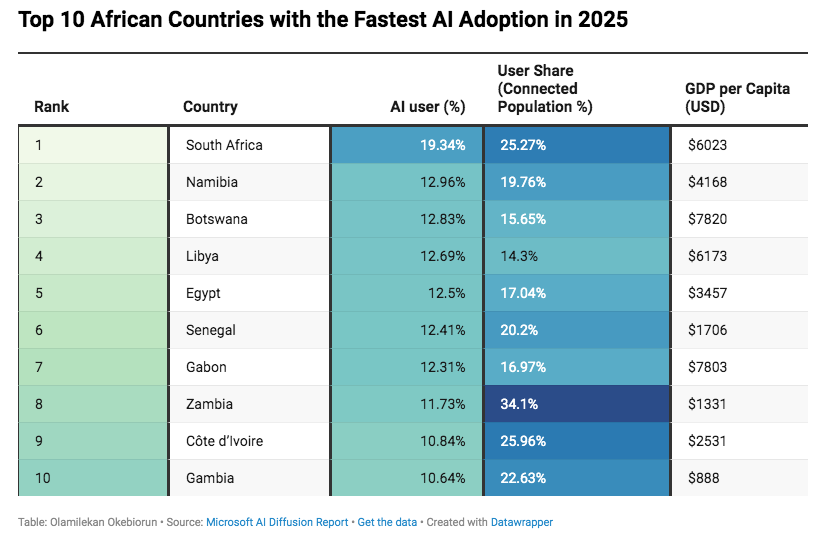
According to the report’s rankings, South Africa ranks first in the whole of Africa with an AI user share of 19.34 percent.
Artificial intelligence has established itself as the fastest-spreading technology in human history. In less than three years, over 1.2 billion people worldwide have used AI tools, a rate of adoption outpacing the personal computer, the smartphone, and the internet. However, this expansion is highly unequal.
Within Africa, the adoption curve is largely dictated by how countries navigate what the report defines as the “Three Forces of AI Diffusion”: frontier builders, infrastructure builders, and users. Because Africa is currently advancing primarily through the user and early infrastructure phases rather than frontier AI development, adoption patterns rely heavily on existing domestic digital readiness.
The report defines AI user share as the percentage of working-age adults using AI tools in 2025. The data underscores a steep divide, only South Africa exceeds the global average AI user share of 15 percent, while all other nations on the continent remain below this benchmark.
Zimbabwe’s omission from the top tier places it alongside other lagging or slower-adopting African nations. Large economies like Nigeria, Ghana, Guinea, Liberia, and Burkina Faso report an AI user share of approximately 8.7%. Other notable baselines include Lesotho at 8.77%, Madagascar at 8.91%, Kenya at 7.83%, and Tanzania at 6.37%. These metrics demonstrate that AI uptake is not determined by a nation’s physical size or GDP alone.
The Microsoft report explicitly points out that AI adoption stands on the shoulders of three preceding general-purpose technologies: electricity, connectivity, and computing infrastructure. Countries with stronger incomes, broader electricity coverage, wider internet access, and higher digital skills consistently record higher adoption rates.
Sub-Saharan Africa faces severe deficits in these areas, accounting for roughly 85 percent of the global population living without electricity. The computing power required to run AI models is highly concentrated, with the United States and China hosting 86 percent of global data centre capacity.
Africa accounts for less than 1% of this capacity, possessing only 121 operational and 49 planned centres across 13 countries, nearly half of which are confined to South Africa, Kenya, Nigeria, and Egypt. This lack of localized infrastructure creates higher latency, reduced performance, and increased costs for users across the region.
Internet connectivity acts as a major gateway, for example, in Zambia, the national AI adoption rate is 12%, but it jumps to 34% among citizens who have internet access. Access alone is insufficient, as digital literacy, AI fluency, and low-resource language constraints continue to present complex barriers to full participation in the AI economy.












Comments