

 By
By 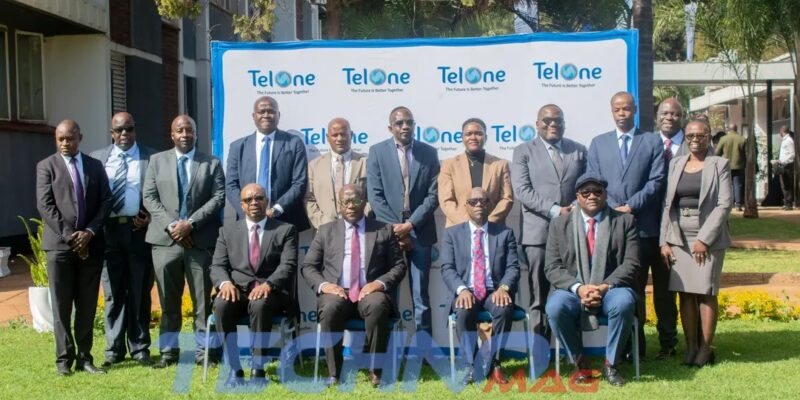
By Ross Moyo
The headline numbers look strong, but the balance sheet tells a harder story. TelOne (Private) Limited closed FY2025 with inflation-adjusted revenue of ZWG2.6 billion, a 10% increase year-on-year. EBITDA rose to ZWG540.37 million from ZWG478.74 million in 2024. Data usage surged 60% and broadband now contributes 81% of revenue. On paper, this is a telco growing with demand. TelOne’s 12th Annual General Meeting revealed this discrepancy held at the TelOne Centre today in Harare.
Engineer Lawrence Nkala,  TelOne CEO said the counterweight is debt. As of 31 December 2025, TelOne reported net assets of ZWG1.4 billion. That apparent strength is overshadowed by a legacy loan book of ZWG10.95 billion, equivalent to about US$421.59 million. The AGM highlights stated it plainly: the debt remains “a major constraint, limiting TelOne’s ability to secure new funding and slowing down critical modernization and digital transformation initiatives.”
Legacy debt is not just an accounting entry. It is a live operational barrier. When a company carries a ZWG10.95 billion overhang, new lenders price in risk. Suppliers tighten terms. Capex approvals get slower. For TelOne, that means the US$7.6 million invested in Fixed Wireless Access and Fibre in 2025 could have been larger, faster, and more widespread without the balance sheet drag.
Liquidity pressure compounded the problem. Throughout 2025, TelOne faced “persistent liquidity pressures” that exerted structural strain on working capital and constrained capex capacity. A key driver was Government receivables, which rose 163% to ZWG857.8 million from ZWG325.3 million in the prior year. When the State is your largest debtor and your lender at the same time, cash conversion cycles stretch.
The funding environment is not helping. The AGM noted that capital mobilization is “constrained, with limited depth in the domestic funding market and cautious investor sentiment.” Currency volatility, economic uncertainty, and regulatory risk have slowed partnerships and investment inflows. TelOne has had to rely on internally generated funds and short-term facilities to keep broadband expansion moving.
The company’s response is debt warehousing. TelOne, in partnership with its Shareholder, revealed it is advancing a strategy to restructure and ring-fence inherited obligations. The objective is to isolate the legacy book so the ZWG1.4 billion net asset base can support new, affordable capital. If executed, this creates a cleaner financial foundation for infrastructure expansion and innovation.
The urgency is tied to technology migration. TelOne lost US$370,524 in revenue and spent US$341,030 on restoration after 336 copper cable theft incidents affected 43,000+ clients. That 1.3% EBITDA erosion highlighted why the company must accelerate migration to fibre and wireless. But fibre rollouts are capital intensive. Without balance sheet relief, migration slows.
The strategic plan is already in motion. TelOne has commenced its 2026 Annual Plan, year one of a 2026-2030 Strategic Plan aligned to NDS2 and Vision 2030. Priorities are revenue diversification, cost efficiency, network modernisation, and customer experience. Execution hinges on a stable macro environment, but also on solving the debt equation.
According to the Telcos latest AGM, the bottom line for stakeholders is TelOne is a growth story trapped in a legacy balance sheet. Data demand is real, Starlink delivered US$3.7m revenue, and FWA is scaling. But until the ZWG10.95bn is warehoused and Govt clears ZWG857.8m, modernization will move in fits and starts. For Zimbabwe’s digital economy, that is the risk to watch in 2026.










Comments