

 By
By 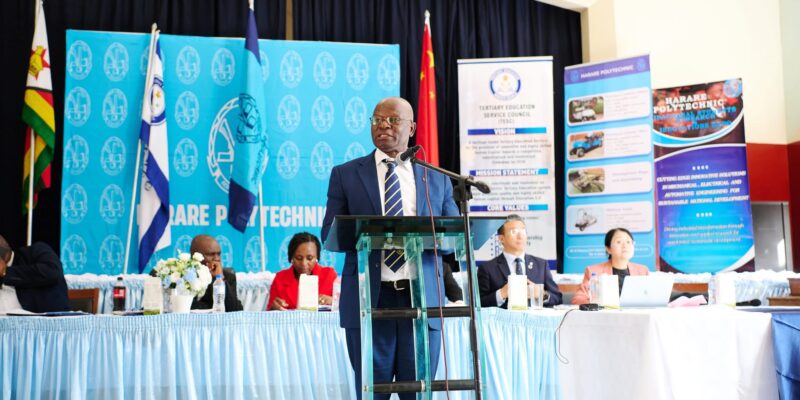
Zimbabwe has expanded a key technical education partnership with China to include all eight polytechnic colleges in a bid to accelerate industrial skills development, technology transfer and innovation.
Speaking at the signing ceremony of a Tripartite Memorandum of Agreement involving Harare Polytechnic, Ningbo Polytechnic University and Huayou Cobalt Company, Secretary for Tertiary Education Service , Eng Tafadzwa Mudondo said that the five-year cooperation agreement between Harare Polytechnic and the Chinese institution would now be broadened into a national program covering every polytechnic in Zimbabwe.
Eng Mudondo said the decision marked a new chapter for Zimbabwe’s Technical and Vocational Education and Training (TVET) sector, ensuring that “no one and no place is left behind.”
Under the new arrangement, all eight polytechnics will gain access to shared curricula, advanced engineering facilities, staff development programs student exchanges and industrial attachments coordinated through the Tertiary Education Services Council.
Mudondo said the council would play a coordination and facilitation role to ensure equitable access and alignment with national education standards and the pillars of the National Development Strategy 2 (NDS2).
“Zimbabwe’s National Development Strategy 2 places skills development, innovation, digitalisation and industrialisation at the centre of our path to an upper middle-income economy by 2030,” he said.
The agreement is expected to strengthen Zimbabwe’s Education 5.0 model, which seeks to transform higher and tertiary education institutions from centres of theoretical instruction into hubs for innovation, industrial production and entrepreneurship.
The partnership would help bridge the gap between classroom learning and industry demands by exposing students to modern manufacturing systems, engineering technologies and industrial processes currently being used in Chinese industries.
Students enrolled under the program are expected to benefit from dual certification arrangements, allowing qualifications to be recognised in both Zimbabwe and China, significantly improving their competitiveness in regional and international labour markets.
The collaboration will also facilitate industrial attachment opportunities with companies such as Huayou Cobalt Company, giving students direct exposure to real-world industrial environments and emerging technologies.
For Harare Polytechnic, the agreement further elevates its position as a national hub for engineering and applied sciences training following plans to jointly establish the Sino-Zimbabwe Engineering Technology Academy and a LUBAN Workshop at the institution.
The facilities are expected to serve as national assets supporting all polytechnics through shared training infrastructure, research collaboration and technical capacity building.
Lecturer development has also been embedded into the agreement through joint training programs, curriculum co-development and industrial attachments aimed at upgrading the skills of Zimbabwean educators to match evolving global industry standards.
Mudondo said sustainable transformation in technical education could only be achieved if lecturers themselves were equipped with modern industrial competencies.
“Without empowered lecturers, no agreement can be sustainable,” he said.
The expanded partnership could help Zimbabwe address long-standing concerns over skills mismatches in the labour market while strengthening the country’s capacity in engineering, mining technology, manufacturing and industrial innovation and also deepen educational and economic ties between Zimbabwe and China.













Comments