

 By
By 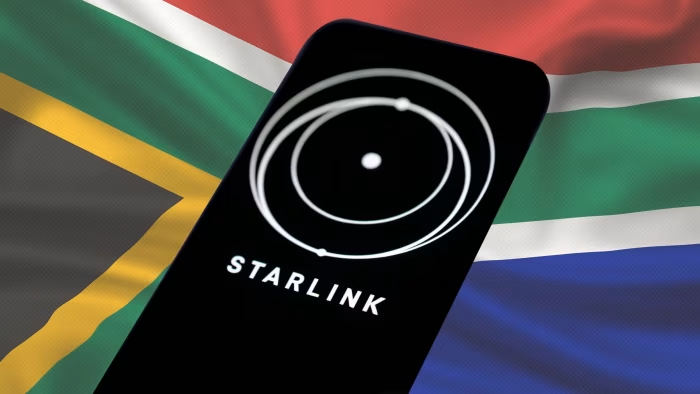
The long-anticipated arrival of SpaceX’s Starlink in South Africa has shifted from a regulatory debate over investment laws into a high-stakes political confrontation. While technical and financial hurdles have historically stalled the satellite giant, the conversation has taken a sharp turn toward the character and politics of its CEO, Elon Musk.
At the center of this new storm is Songezo Zibi, leader of the political party Rise Mzansi. In a series of recent statements, Zibi has voiced a hard no on licensing Starlink, arguing that the service is unwelcome not because of its business model, but because of Musk himself, citinf a clash of values.
Zibi’s opposition is rooted in what he describes as a series of serious red flags. The primary catalyst for this latest outcry is a controversial gesture Musk allegedly made at a post-inauguration rally for U.S President Donald Trump.
While critics claim Musk gave a Nazi salute, the billionaire has dismissed the accusations as tired dirty tricks, asserting the gesture was a misunderstood wave to the crowd. Not long after his AI Grok also started giving unrelated answers to questions praising Hitler.
However, Zibi remains unconvinced. Beyond the salute, he accuses Musk of using his platforms to spread dangerous misinformation and allowing others to propagate narratives regarding South African farm attacks that could destabilize the nation’s international relations.
“Musk knows the harm that ill-informed tariffs or sanctions could cause millions of South Africans, but he persists anyway,” Zibi wrote in a blog post. He further claimed that those supporting Starlink are willing to ignore these moral concerns simply because they hate Black Economic Empowerment (BEE).
The BEE mentioned by Zibi refers to the Electronic Communications Act, which requires telecommunications operators to be at least 30% owned by historically disadvantaged groups. This category includes Black Africans, Coloureds, Indians, and in some instances, Chinese South Africans, as well as women, youth, and people with disabilities.
Musk has been vocal about his disdain for these race-based laws.
Not too long ago, he posted (and later deleted) a claim that Starlink is barred from South Africa simply because he is not Black. He argued that South Africa now has more anti-White laws than there were anti-Black laws under Apartheid, a statement that has drawn fierce criticism from local leaders like Zibi, who view it as an erasure of historical context.
Despite the rhetoric, SpaceX has attempted to find a middle ground. The company has proposed an Equity Equivalent Investment Programme (EEIP). Instead of ceding 30% ownership, Starlink would invest directly in the country’s development.
The proposed peace offering is substantial. R500 million ($27.6 million) to provide free, high-speed internet and hardware to 5,000 rural schools, benefiting an estimated 2.4 million children. And a total planned investment of R2 billion to partner with local companies for business products and infrastructure rollout.
The ball is currently in the court of the Independent Communications Authority of South Africa (Icasa). Communications Minister Solly Malatsi has already instructed the regulator to align its rules with the national economic inclusion policy, potentially opening the door for EEIPs in the tech sector.






Comments