

 By
By 
Satellite internet provider Starlink has begun actively enforcing its Fair Use Policy across Residential and Roam accounts, placing strict 10 Megabits per second (Mbps) speed caps on extreme bandwidth consumers to mitigate network congestion.
In high-density urban areas where Residential packages have frequently faced capacity limits, some users have operated informal commercial Wi-Fi distribution schemes using standard home kits. This policy directly targets that loophole.
The move targets accounts consuming massive amounts of data, frequently exceeding 5 Terabytes (TB) per month or running daily downloads over 500 Gigabytes. Affected subscribers are receiving “Terms of Service Violation” notifications warning that Residential and Roam plans are strictly intended for personal, family, or household use.
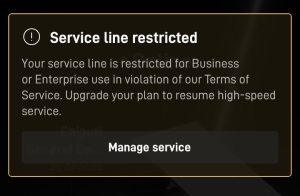
Starlink’s automated systems flag these extreme consumption profiles as unauthorized commercial reselling, business operations, or severe network abuse on non-enterprise tiers.
To restore unrestricted high-speed internet for the remainder of their billing cycle, flagged users are required to upgrade to a Priority plan designed for Business or Enterprise operation.
For average household users in Zimbabwe, this enforcement shift brings minimal disruption and substantial performance benefits.
Typical household activities such as 4K video streaming, online gaming, remote work, and regular software updates consume well under 1 TB per month. Everyday subscribers will notice no change to their service.
Flagged accounts are not cut off outright, instead, their download speeds are capped at approximately 10 Mbps during peak periods to protect overall network integrity for the wider community.
In congested cells across Harare and Bulawayo, high localized demand has occasionally impacted peak-hour speeds. By curbing extreme consumption, Starlink aims to ensure cleaner bandwidth distribution and improved peak-hour performance for regular, paying subscribers.
Subscribers attempting to bypass the speed restriction by canceling and re-registering under a different name will find little success, as Starlink attaches TOS violations directly to the unique hardware identifier (KIT ID) of the dish terminal.
High-volume commercial operators in Zimbabwe will ultimately need to transition to official Priority plans to maintain high-speed service.












Comments