

 By

The latest refresh of Starlink’s official Speed and Latency Map, has cast a sharp focus on broadband performance disparities across Southern Africa. While SpaceX’s satellite internet continues to transform connectivity across the continent, data from the updated map reveals that Zimbabwe currently contends with the lowest average download speeds in the region, trailing significantly behind its active peers.
According to the updated metrics, Starlink performance in Zimbabwe spans a wide bracket, recording download speeds between 13 Mbps and 253 Mbps, paired with upload speeds ranging from 8 Mbps and 41 Mbps.
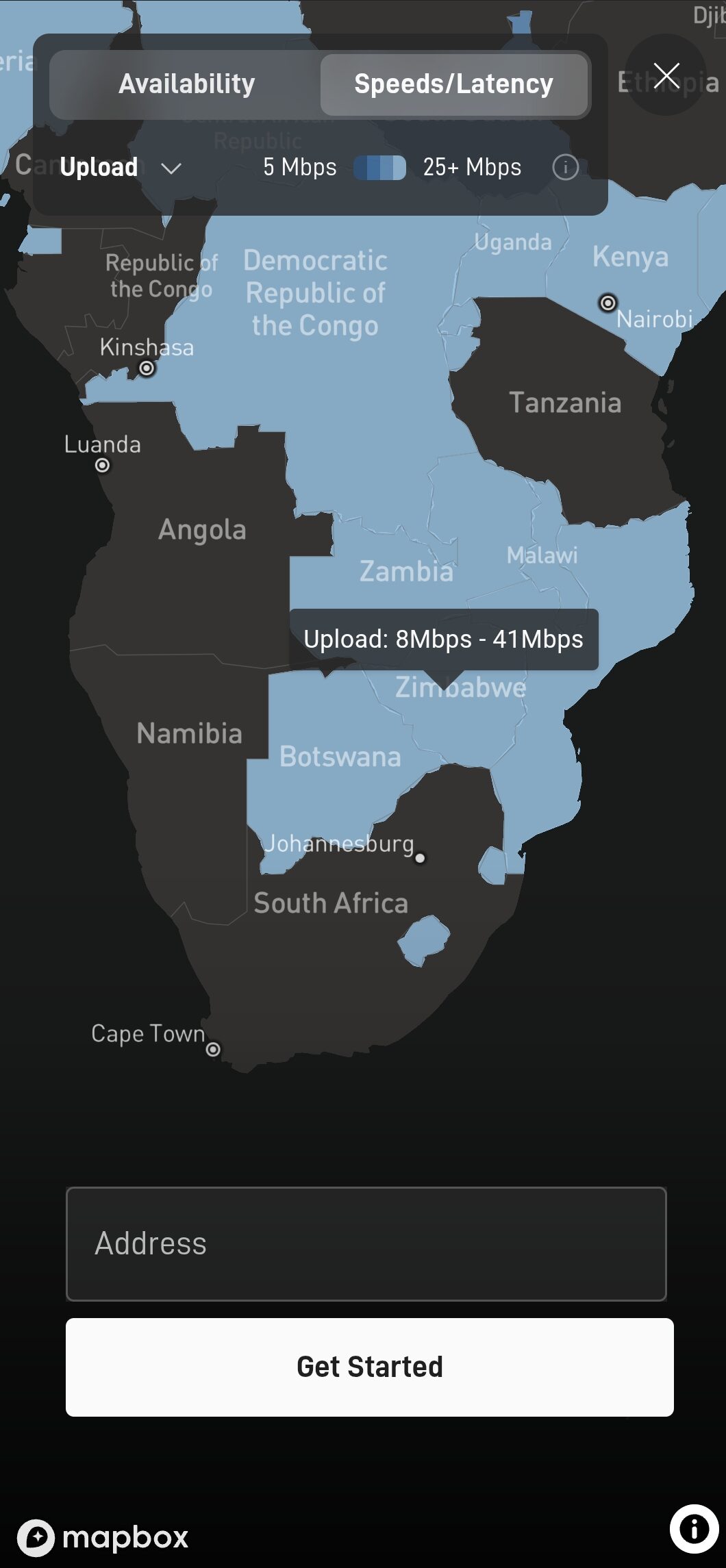
While peak upper limits demonstrate the theoretical capacity of low-Earth orbit (LEO) technology, the depressed lower-end baseline highlights severe operational constraints during peak usage hours.
A cross-border review of the updated November map underscores a profound performance gap between Zimbabwe and other regional markets where Starlink is officially operational.
While Zimbabwe registers the lowest baseline floor in the region, other Southern African nations showcase robust throughput capacity.
According to Starlink’s official website Lesotho leads the region with top-tier performance, recording download speeds of 256 Mbps to 387 Mbps and upload speeds between 40 Mbps and 63 Mbps.
Eswatini follows closely behind with impressive downloads ranging from 246 Mbps to 357 Mbps and uploads of 38 Mbps to 58 Mbps.
Malawi als demonstrates strong performance with download speeds between 224 Mbps and 322 Mbps and uploads of 36 Mbps to 51 Mbps.
Botswana logs solid speeds spanning 181 Mbps to 347 Mbps download and 33 Mbps to 58 Mbps upload.
Mozambique records download capabilities between 152 Mbps and 321 Mbps alongside 30 Mbps to 52 Mbps upload while Madagascar measures download performance between 95 Mbps and 301 Mbps and uploads from 21 Mbps to 49 Mbps.
Zambia shares a lower baseline floor similar to Zimbabwe, with downloads between 86 Mbps and 253 Mbps and uploads matching Zimbabwe’s range at 8 Mbps to 41 Mbps.
The stark contrast between Zimbabwe and regional leaders like Lesotho and Eswatini raises critical questions regarding what is driving down performance metrics within Zimbabwean cells.
Starlink has experienced massive adoption rates in urban and peri-urban centers like Harare, where consumers rushed to bypass legacy terrestrial ISPs. Because LEO satellite bandwidth is a finite resource shared across active terminals within a specific geographical cell, high user concentration quickly leads to heavy network contention.
The dramatic spread in Zimbabwe’s download speeds from a sluggish 13 Mbps floor up to 253 Mbps strongly indicates severe congestion during peak evening hours when user demand spikes simultaneously.
Another contributing factor is bottlenecks in regional ground gateway routing, peering infrastructure, or local terrestrial backhaul integration can restrict overall throughput and increase latency.
For Zimbabwean digital professionals, remote workers, and households relying on Starlink as a high-speed lifeline, the November map update serves as both a validation of satellite internet’s potential and a stark warning sign of infrastructure strain.
As demand continues to surge, optimizing local cell capacity and expanding ground gateway infrastructure will be crucial if Zimbabwe is to close the performance gap with its high-flying Southern African neighbors.












Comments