

 By
By 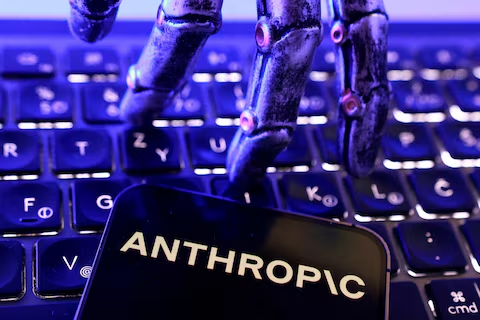
Tech giant Anthropic has abruptly disabled global access to its newly launched flagship AI models following a sweeping United States government export control directive. The June 12 order mandates the immediate suspension of model access for all foreign nationals over national security concerns, leaving users across the globe including developers and businesses here in Zimbabwe completely cut off from the frontier technology.
The sudden ban centres on an alleged jailbreak vulnerability. US authorities claim to have discovered a method allowing users to bypass safety guardrails to read codebases and identify software flaws.
Because the directive explicitly bars any foreign national from utilising the system, Anthropic was forced to shut down the models for everyone worldwide to ensure compliance, as filtering individual users by citizenship instantly proved impossible.
For Zimbabwe’s growing tech sector, the directive highlights the geopolitical fragility of cloud-based AI access. As a foreign nation, Zimbabwe falls squarely under the blanket suspension. Local enterprises and researchers who had just begun exploring Anthropic’s most advanced reasoning engines are now locked out without prior notice.
While the ban disables Anthropic’s top-tier systems, the company confirmed that access to its older portfolio remains unaffected. Anthropic’s current roster of AI models includes:
• Claude Fable 5: The highly advanced, widely released model for complex reasoning and agentic workflows (Currently Suspended).
• Claude Mythos 5: The enterprise-focused tier lacking default safety classifiers, available via Project Glasswing (Currently Suspended).
• Claude Opus 4.8: The most capable model currently available to the general public.
• Claude Sonnet: The mid-tier model balancing speed and intelligence for enterprise tasks.
• Claude Haiku: The fastest, most compact model designed for simple, rapid, high-volume queries.
In a strongly worded response, Anthropic rebuked the US government’s technical rationale. The company argues that the alleged bypass is a minor, non-universal flaw whose capabilities are widely present in rival commercial models, such as OpenAI’s GPT-5.5, and is routinely used by cybersecurity defenders.
Anthropic emphasised its defence in depth strategy, combining thousands of hours of red-teaming with a strict 30-day data retention policy to study and mitigate bypasses.
The company warned that if the government’s low threshold for recalling models were applied industry-wide, it would essentially halt all frontier AI deployments globally. While Anthropic is complying with the legal directive, it labelled the incident a misunderstanding and is working to restore global access.











Comments