

 By
By 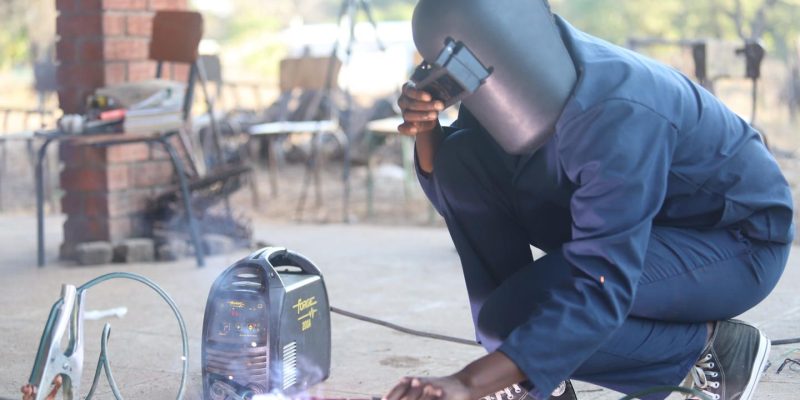
By Ross Moyo
The UNDP, Ireland, EU and FAO are suppprtong many Zimbabweans including at 25, Evelyn Mundauya rebuild her life after leaving an abusive polygamous marriage and returning home to Manjinji in Ward 15, Chiredzi District, with her five-year-old child.
For Mundauya, returning home was a difficult decision but she says staying in circumstances that were harming her was not an option. She needed to find a way to provide for her child and stand on her own feet.
That search led her to skills training supported through the Zimbabwe Resilience Building Fund Phase Two, known as ZRBF II.
She is now undertaking a welding course, gaining practical skills she hopes will become an income-generating enterprise. For her, the training goes beyond learning how to weld. It has given her a sense of purpose and a renewed belief that she can create opportunities for herself.
“I want to start something of my own,” she said. She dreams of establishing a welding enterprise in her community, noting that there are currently no similar services in her area. She sees an opportunity to provide products and services closer to home while generating income.
Mundauya’s experience is part of a wider investment in young people across Zimbabwe’s south-east lowveld, where ZRBF Phase Two is supporting communities to strengthen resilience by expanding access to skills, livelihoods and economic opportunities.
The programme is being implemented with guidance from the Government of Zimbabwe, with financial support from the European Union and the Government of Ireland. The United Nations Development Programme manages and coordinates ZRBF II, with technical support from the Food and Agriculture Organisation in natural resource management and agriculture, and strengthened by the Resilience Knowledge Hub led by Mercy Corps through evidence generation. In the south-east lowveld, implementation is being led through the RECLAIM Consortium led by Care International.
Together, the partners are supporting communities to identify practical and locally relevant pathways towards stronger livelihoods.
Through ZRBF II, young people are being equipped with market-oriented skills in areas including climate-smart agriculture, confectionery, welding and entrepreneurship. The aim is not only to provide training but to help young people turn skills into livelihoods, livelihoods into enterprises and enterprises into stronger households and communities.
So far, 240 young people have benefited from skills development and entrepreneurship initiatives in the south-east lowveld, and the programme has identified more than 1,000 additional young people for similar opportunities as it expands.
For young people in communities where formal employment is limited and livelihoods are exposed to economic and climate pressures, practical skills can create new possibilities.
For Mundauya, the opportunity is deeply personal. She thinks daily about providing for her child and building a more secure future. She acknowledges that starting a business will not be easy and will require equipment, capital, customers and persistence, but says she now has a skill to build on and a clear vision.
“There is no one providing these services in my area,” she said, pointing to the gap she hopes to fill.
Her sentiments are shared by other young people in the programme. Donald Muraicho, one of those under training, said once he completes the course he will have a certificate to help him find a job and improve his life.
“Once I complete the course, I will have a certificate to help me find a job and improve my life by gaining practical experience in the field. However, with all things constant, I intend to save enough money so that once I have gained sufficient business management experience, I can start my own business,” he said.
Through ZRBF II, the investment goes beyond training to strengthening the resilience of families and communities. For Evelyn, her second chance may start with a welding machine, a business in her community and the determination to make it work.









Comments