

 By
By Ross Moyo
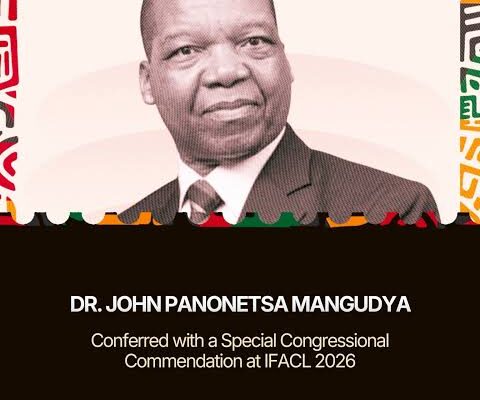
Exactly a month ago today, on 24 September 2026, Dr John Panonetsa Mangudya stood in New York and received a Special Congressional Commendation at the International Forum on African-Caribbean Leadership.
The date matters. The commendation was not a retrospective lifetime award. It was conferred in the middle of United Nations General Assembly week, at a forum designed to turn speeches into investment deals, and it was given to the man now in charge of Zimbabwe’s largest concentration of public wealth.
The forum, the 12th edition of the International Forum on African-Caribbean Leadership, known as IFACL 2026 and also styled IFAL 2026, was held on 24 September at the New York Marriott Marquis on the sidelines of the 81st United Nations General Assembly. It was organised by the African Leadership Organisation, publishers of African Leadership Magazine, under the theme “The Global African Alliance: Reimagining Solidarity, Sovereignty and South-South Cooperation,” with a focus on dismantling barriers to direct trade between Africa and the Caribbean, strengthening internal accountability, bridging the logistics gap and mobilising diaspora capital.
Mangudya was honoured for leadership in national investment and for his contribution to Zimbabwe’s economic development. In his special presentation at the forum, he spoke to the role of strategic investment in building a stronger, more self-reliant Africa.
A month later, that framing is now measurable against the portfolio he leads.
Mangudya was appointed to lead the Mutapa Investment Fund on 1 May 2024, after a decade as Governor of the Reserve Bank of Zimbabwe from 2014 to 2024. He brought more than 38 years of experience spanning banking, economic research and corporate governance, including roles as Chief Economist at the Reserve Bank, international banker at Afreximbank and Group Chief Executive Officer of CBZ Bank.
The Mutapa Investment Fund, formerly the Sovereign Wealth Fund of Zimbabwe, is Zimbabwe’s sovereign wealth fund and holding company for more than 30 commercial state enterprises. Its portfolio spans energy, mining, transport, telecommunications, agriculture, banking and industry, and includes ZESA, Kuvimba Mining House, NetOne, TelOne, Air Zimbabwe, National Railways of Zimbabwe, Cottco, Zupco, People’s Own Savings Bank, Fidelity Gold Refinery and Homelink, among others.
For the 2025 financial year, the Fund reported total assets of approximately US$16.5 billion, up from US$14.9 billion the previous year, a rise of 10.7 percent. Total income surged by 406 percent to US$60.34 million. Surplus after tax rose by 502 percent, from US$3.58 million to US$21.67 million. Comprehensive income increased by 139 percent to about US$1.4 billion, driven by fair value gains across the asset base. Gearing was held at 8 percent.
Portfolio companies have paid cumulative dividends of US$93 million to the Fund, against gross disbursements of US$152 million to portfolio companies. In January 2026, Mangudya formally committed the Fund to the Santiago Principles, aligning Zimbabwe’s sovereign investment framework with international benchmarks for transparency, governance and accountability.
In 2025, the Fund secured more than US$1 billion in infrastructure financing deals focused on energy grid rehabilitation, logistics upgrades and national asset enhancement. It established a further US$1.075 billion project pipeline for execution in 2026, leveraging public-private partnerships.
The New York commendation was not Mangudya’s only recognition this year. On 8 July 2026, he received the African Sovereign Investment Leadership Excellence Award at the 16th African Business Leadership Awards in London, for transforming Mutapa into a commercially disciplined, transparent and high-performing institution.
Two months after New York, the Fund has continued to report progress in restructuring state enterprises. In a recent presentation to participants at the National Defence Course at the Zimbabwe National Defence University, Mangudya said the Fund was pursuing measures to unlock value, improve performance and generate sustainable returns. The Fund says its gross asset value is now more than US$16 billion, with additional resources being mobilised to recapitalise companies in its portfolio.
The scale of the challenge remains large. The Fund itself has estimated that more than US$10 billion would be required to modernise and restore the productive capacity of its portfolio companies. That is the context in which the New York commendation will ultimately be judged, not by the applause in the Marriott Marquis on 24 September, but by whether the US$16.5 billion portfolio can be turned into sustained production, jobs, housing and returns.
For now, the award stands as a marker: on 24 September 2026, in front of heads of state, central bankers, policymakers and diaspora business leaders gathered for UNGA 81, Zimbabwe’s sovereign wealth chief was singled out for the way he is trying to make state ownership work as investment, rather than as administration.









Comments