

 By
By 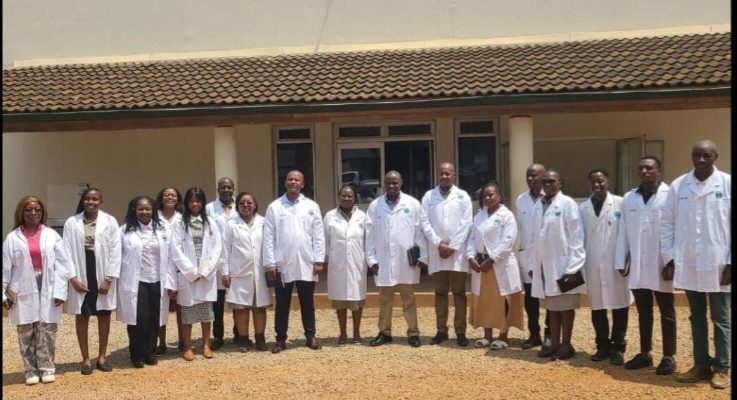
The Environmental Management Agency (EMA) is expanding its use of advanced laboratory technology to improve the speed and accuracy of detecting pollution in Zimbabwe’s water, soil, air and plant materials.
The agency’s national laboratory is equipped with specialised scientific instruments used to analyse environmental samples, allowing Zimbabwe to conduct a wide range of tests locally instead of sending samples to laboratories outside the country.
The technology is being used to support the detection of contamination, pollution incidents, industrial discharges, spillages and other environmental threats, with results expected within specified turnaround times.
Speaking during a media tour of the laboratory, EMA Laboratory Manager Sylvia Yomisi said the agency was continuously investing in equipment, maintenance and staff training as it works towards becoming a regional environmental reference laboratory by 2030.
“We have state of the art equipment in the laboratory, and we maintain and service it to make sure the performance is up to expectation,” she said.
The laboratory’s technological capabilities cover four major environmental areas , air, soil, water and plant material.
According to Yomisi, the chemistry section conducts about 60 different tests, while microbiology has 10 tests, soil has 17 and air has 10.
The technology is particularly important in monitoring water quality, with EMA operating 334 sampling points across the country under its national water-quality programme. Samples from ambient water, wastewater and industrial, mining, sewage and agricultural effluent can be analysed to establish their environmental condition.
The laboratory’s use of modern testing equipment also reduces the time and cost associated with sending samples abroad, while allowing environmental authorities to obtain scientific evidence needed when responding to pollution incidents.
Yomisi said the laboratory must be able to provide accurate results quickly because environmental emergencies can require immediate action.
“There will be some issues in the environment, accidents, spillages, poisoning, and we need to give back results within the specified turnaround time,” she said.
Technology, however, is only one part of the laboratory’s operations. The facility employs 19 people, including chemists, microbiologists and technicians, who undergo continuous training and assessment to ensure they can operate the specialised equipment and maintain the required standards.
The laboratory has been accredited to the ISO/IEC 17025 international standard since 2012, meaning its testing and calibration operations must meet internationally recognised requirements for competence.
Maintaining that standard requires regular calibration, servicing and maintenance of laboratory equipment. EMA recently engaged a consultant from South Africa to service some of its specialised instruments.
The agency also provides laboratory testing as a commercial service to farmers, NGOs, local authorities, industries and other Government departments, while working towards decentralising its services so that clients across the country can access testing closer to their locations.
Despite the technological advances, EMA faces challenges in maintaining and expanding its capabilities. Much of the specialised equipment and laboratory consumables have to be imported, while funding limitations can affect procurement and expansion.
Yomisi said the shortage of locally manufactured laboratory equipment creates additional difficulties in maintaining the technology.
For EMA, continued investment in scientific equipment, skilled personnel and laboratory infrastructure is therefore central to its ambition of developing a facility capable of serving not only Zimbabwe but eventually becoming a regional environmental reference laboratory by 2030.











Comments