

 By
By Ross Moyo
Zimbabwe has the waterfalls, the wildlife, the heritage and the welcome. What will decide whether it becomes a world-class destination is something far more ordinary – and far more revealing: whether its streets, towns and townships are clean.
Zimbabwe does not lack beauty. It has Victoria Falls, one of the Seven Natural Wonders of the World. It has Hwange, Mana Pools, Matobo Hills, Great Zimbabwe, the Eastern Highlands, Gonarezhou, and a living culture that stretches from stone enclosures built centuries ago to mbira music that still carries across villages at night.
What Zimbabwe has struggled with, in the eyes of many visitors, is not what is on the postcard. It is what is on the road to the postcard as NetOne Public Relations Manager Ernest Magadzire confirmed connectivity is beyond telcos and borders also on shared responsibility for the environment.
NetOne Public Relations Manager, Mr Ernest Magadzire, has previously underscored the organisation’s broader national development responsibility, noting that its contribution extends beyond digital connectivity.
“As NetOne marks 30 years of connecting Zimbabwe, the organisation remains committed to ensuring that its contribution to national development extends beyond digital connectivity.”
In a more recent account of the company’s community work, Magadzire put it even more plainly:
“As NetOne celebrates 30 years of connecting Zimbabwe, we recognise that meaningful connectivity extends beyond telecommunications. It is also about connecting communities to a shared responsibility for the environment in which we live and work”.
That framing – connectivity as citizenship – is visible across NetOne’s anniversary programme: from its 30-district medical outreach targeting 90,000 households, to its Health on Wheels solarised, Starlink-enabled kiosks, to its clean-up drive.
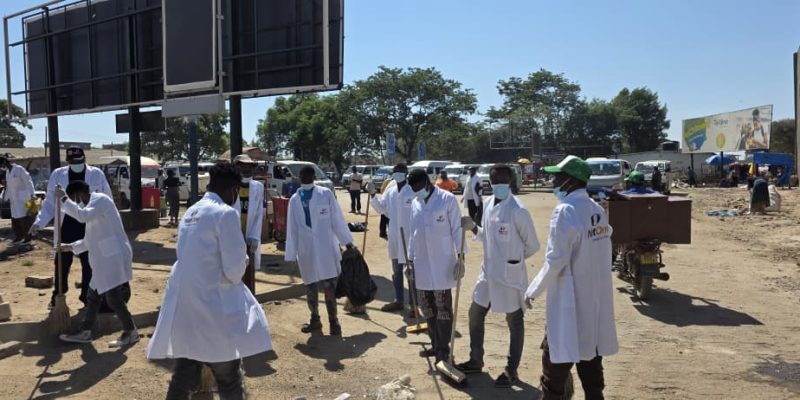
The clean-up programme, in that sense, is not charity. It is ESG in practice: Environmental, Social and Governance commitments translated into gloves, bags, and streets that look different by 10am.
Litter in the central business district. Uncollected waste at bus termini. Plastic in drains. Overflowing bins at shopping centres. For a tourist, that first impression is not a footnote. It is the destination.
That is why the conversation about cleanliness in Zimbabwe is no longer a conversation about brooms. It is a conversation about economics, about public health, about national pride, and about whether the country can convert its extraordinary natural endowment into a US$10 billion tourism economy by 2030.
The numbers tell a story of momentum
The data, for once, is on Zimbabwe’s side.
In 2024, Zimbabwe welcomed more than 1.6 million international tourists, generating over US$1.2 billion in revenue and attracting US$190.5 million in investment into the sector.
The momentum did not stop there. In the third quarter of 2025 alone, the country recorded 496,668 tourist arrivals, up from 450,922 in the same period in 2024 – a 10.1 percent year-on-year increase, according to the Zimbabwe National Statistics Agency (ZimStat).
Room nights occupancy rose from 47.5 percent in Q3 2024 to 52.4 percent in Q3 2025. Holidaymakers, the largest single group, jumped 18 percent to 256,143 in that quarter, while business visitors surged 43 percent, from 82,454 to 118,496.
In the first quarter of 2026, arrivals rose another 11 percent to 384,515, with total tourism revenue up 14 percent to US$251 million.
And then came the endorsement that money cannot buy: Forbes Magazine named Zimbabwe the World’s Best Country to Visit in 2025.
That is the opportunity. The risk is that visitors arrive expecting the Forbes headline, and meet the littered street.
Cleanliness is the visitor experience
Tourism research is consistent on one point: visitors do not separate the attraction from the journey to it.
A tourist’s experience begins at the airport, continues through the city, along the highway, at the fuel station, at the roadside market, and only then at the Falls or the national park. If any link in that chain is dirty, unsafe, or neglected, the memory that travels home is not the waterfall – it is the waste.
That is why the First Lady of the Republic of Zimbabwe, Dr Auxillia Mnangagwa, has placed environmental cleanliness at the centre of her work as Environment Patron. Her advocacy is not ceremonial. It is strategic.
Through community-based initiatives, she has consistently encouraged Zimbabweans to embrace cleanliness as a daily responsibility, not an activity reserved for the first Friday of every month.
It is a message that carries particular significance for tourism. A destination’s attractiveness is not defined by its tourist attractions alone, but also by the condition of the environment visitors encounter along the way.
The First Lady’s message aligns with the national cleanliness agenda championed by His Excellency, President Cde Dr E.D. Mnangagwa, who on 5 December 2018 declared the first Friday of every month as National Environment Cleaning Day. The initial commemoration was held at Takashinga Sports Club in Highfield, Harare, led by the President himself.
The declaration was grounded in the Constitution itself – Section 73, which provides for the right to an environment that is not harmful to health and well-being.
Eight years later, the initiative continues to thrive. As one report noted: “Seven years after President Mnangagwa’s declaration, the National Environment Clean-up Day initiative, continues to thrive”.
From Harare CBD to every province
In support of that agenda, NetOne is widening its participation in the monthly National Clean-Up Campaign, with a November programme covering communities across Zimbabwe and a broader commitment to extend environmental action to all provinces, leaving no one and no place behind.
The mobile network operator’s planned activities this month include Chinhoyi, Bindura, Harare CBD, Chitungwiza, Harare North, Bulawayo, Zvishavane, Mutare and Masvingo. The programme builds on the organisation’s participation throughout the year.
In Harare’s central business district, NetOne will participate alongside the Ministry of ICT, Postal and Courier Services, other sector players, the City of Harare and the Environmental Management Agency (EMA). The exercise brings public institutions and businesses together in a shared effort to improve the surroundings in which people work, trade and travel.
That partnership matters. No single company, council or ministry can clean a country. But a coalition can change a culture.
The company’s ambition to extend participation to every province is intended to broaden community involvement rather than concentrate environmental activities in the capital. The November locations represent part of that wider commitment, with the ultimate objective of strengthening environmental action across the country.
NetOne at 30: Beyond connectivity
For NetOne, this is not a side project. It is part of how the company is defining its 30th year.
NetOne was born in 1996 as Zimbabwe’s first mobile telecommunications operator, laying the foundation for a digital revolution. Today, as it celebrates its Pearl Anniversary, its story reads less like a corporate history and more like a chronicle of national transformation.
The Bulawayo moment: When churches lead
In Bulawayo, the November programme has taken on a distinctive character.
Churches operating under the Zimbabwe Heads of Christian Denominations have invited NetOne’s regional leadership to the first anniversary of their clean-up drive on Friday, November 6.
The proposed concluding meeting at the City Hall Car Park, from 10am to 10.30am, will include corporate-sector remarks from NetOne alongside contributions from environmental and local government stakeholders.
That invitation matters for two reasons.
First, it shows that the clean-up agenda has moved beyond government and corporates into the moral heart of communities – the churches, the congregations, the neighbourhoods where cleanliness is lived, not legislated.
Second, it shows continuity. A first anniversary is not a launch. It is proof that a community kept going after the cameras left.
In a city like Bulawayo – Zimbabwe’s second city, a cultural capital, a gateway for tourists heading to Matobo, Hwange and Victoria Falls – that continuity is tourism infrastructure, even if it is never listed in a tourism brochure.
The hard truth: waste is still a national challenge
To be honest, Zimbabwe still has a long way to go.
According to a 2011 study by the Institute of Environmental Studies at the University of Zimbabwe, the country generates 1.65 million tonnes of waste per year. Much of that waste is still poorly collected, poorly sorted, and poorly recycled.
Harare, Bulawayo and other cities have faced persistent challenges with refuse collection, illegal dumping, and blocked drains – problems that become public health crises when cholera and typhoid strike. The clean-up campaign, as EMA itself has noted, is aimed at creating a cleaner and healthier environment to fight diseases such as cholera and typhoid.
Rwanda is often cited as Africa’s model. After the 2000s, when garbage and burning trash were common, Rwanda institutionalised a compulsory national clean-up – Umuganda – for able-bodied citizens aged 18 to 65, monitored by police. Zimbabwe’s model remains voluntary, between 8am and 10am on the first Friday of every month.
The question for Zimbabwe is not whether to copy Rwanda. It is whether voluntary commitment, led by the President, the First Lady, corporates like NetOne, churches, councils and citizens, can achieve the same result without compulsion.
The evidence from November suggests it can – if the effort is sustained, decentralised, and treated as daily discipline, not monthly ritual.
What world-class really means
Zimbabwe has set an ambitious target to build a US$10 billion tourism economy by 2030, building on surpassing the previous US$5 billion goal in 2024.
That target will not be met by arrivals alone. It will be met by spend per visitor, length of stay, repeat visits, and reputation. And reputation is built, street by street.
A clean Zimbabwe is not only a healthier place to live and work. It is a more attractive destination to visit, explore and invest in.
Every clean street, well-maintained public space and responsibly managed community contributes to the country’s image and reinforces the message that Zimbabwe is ready to welcome the world.
For NetOne, supporting the First Lady’s environmental advocacy and Government’s cleanliness agenda is part of translating national aspirations into practical community action.
Ultimately, the broom is not just a broom. It is the foundation.












Comments