

 By

By Ross Moyo
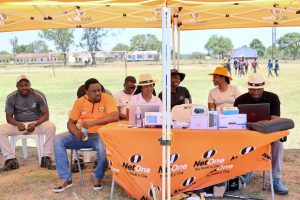
NetOne has pledged to use its national network to ensure no learner is left behind in Zimbabwe’s digital transformation, as the Digitalize Zimbabwe ICT Expo Programme rolled into Mberengwa for a Schools Fair that brought together schools, innovators, government and the private sector.
Speaking at the fair, the NetOne Group Chief Executive Officer said digital technology is no longer a luxury but an essential tool for education, economic development and national progress.
“It is a great honour and privilege to join you here in Mberengwa for this significant Schools Fair, which provides a valuable platform to celebrate education, technology, creativity and innovation,” he said.

The Mberengwa Schools Fair is part of a national drive navigating all ten provinces of Zimbabwe, bringing digital opportunities, technological awareness and innovation closer to communities, particularly schools and young people.
The programme is a partnership between the Ministry of Information Communication Technology, Postal and Courier Services, Mutapa Energy Resources, Video Promotions and NetOne.
NetOne is party to a tripartite Memorandum of Understanding signed between the participating partners to support the implementation of the programme. Under the MOU, NetOne is committed to providing network connectivity, including live-streaming capabilities and on-site technical support, to ensure the smooth delivery of exhibitions.
It will also provide technical support in visibility, exhibitions and branding, helping to create an engaging platform for institutions, innovators and learners to showcase products, ideas and technological solutions.
The GCEO said the initiative directly contributes to Vision 2030, which seeks to transform Zimbabwe into an empowered and prosperous upper-middle-income society, and complements National Development Strategy 2 (NDS2), the national framework for accelerating economic growth, strengthening productive sectors, promoting innovation and harnessing technology to improve livelihoods.
“Achieving this vision requires investment in human capital development, technological advancement, innovation and the expansion of digital infrastructure to ensure that no community is left behind,” he said.
Zimbabwe’s digital challenge is stark. According to the Postal and Telecommunications Regulatory Authority of Zimbabwe (POTRAZ), mobile penetration is over 100 percent, but internet penetration remains below 75 percent, and rural broadband access is far lower. According to the Ministry of Primary and Secondary Education, less than 40 percent of rural schools have reliable internet, compared to over 85 percent of urban schools. Many schools in districts like Mberengwa still rely on a single computer lab, intermittent power and teachers who have never received formal ICT training.
That is why the Mberengwa fair matters. It is not a Harare event brought to the rural areas for a photo. It is a test of whether the national digital agenda can work where the need is greatest.
“Digital transformation is therefore not simply about adopting new technologies, it is about creating opportunities, improving service delivery, empowering communities and building a competitive, knowledge-driven economy,” the GCEO said.
He told learners that their geographical location should never determine their access to digital opportunities.
“Whether a child is in Mberengwa, Harare, Bulawayo or any other part of Zimbabwe, they deserve an opportunity to access information, acquire digital skills and participate in the knowledge economy.”
He urged them to move beyond being consumers of technology to becoming creators, innovators and problem-solvers, and to explore coding, robotics, artificial intelligence, digital entrepreneurship and software development.
“You could be the next software developer, robotics engineer, digital entrepreneur or technology innovator who develops solutions to challenges facing our communities and country. The next big technological innovation could come from a learner right here in Mberengwa,” he said.
He also paid tribute to teachers, describing them as being at the centre of preparing the next generation for a technology-driven world, and encouraged schools to embrace digital learning and integrate ICT into teaching.
“As NetOne, our commitment remains clear, to connect people, empower communities and contribute to a digitally enabled Zimbabwe. Together, let us turn the aspirations of Vision 2030 and the priorities of NDS2 into tangible realities,” he concluded.










Comments