

 By
By 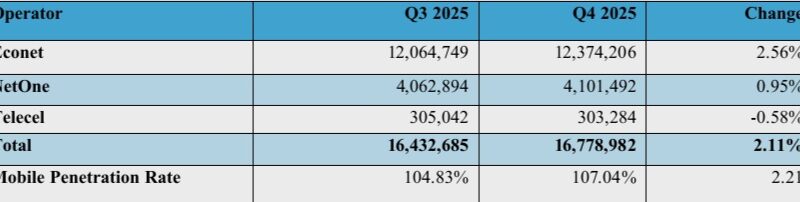
Zimbabwe’s mobile telecommunications sector recorded steady growth in the fourth quarter of 2025 with the national mobile penetration rate rising to 107.04%, up from 104.83% in the previous quarter. This is according to the latest Postal and Telecommunications Regulatory Authority of Zimbabwe (POTRAZ) sector performance report, which shows renewed subscriber gains and increasing reliance on mobile services across the country.
The rise in mobile penetration was driven by a 2.11% increase in active mobile subscriptions, from 16,432,685 in Q3 to 16,778,982 in Q4 2025.The continued increase in subscriptions highlights the central role mobile connectivity plays in Zimbabwe’s communication and digital environment.
POTRAZ attributes the growth to expanding network coverage, service upgrades, improved device access, and rising consumer demand for reliable mobile data and communication services.
The regulator noted that operators have intensified their rollout of high speed infrastructure, improving network availability across both urban and rural areas.
The strongest growth came from the country’s largest operator, Econet Wireless, which added 309,457 subscribers during the quarter. The increase pushed Econet’s total customer base to 12.37 million, reinforcing its dominant market position. Econet also gained 0.33 percentage points in market share, consolidating its lead over competitors.
NetOne also posted positive growth, adding 38,598 new subscribers an increase of 0.95% to close the quarter at 4,101,492 subscribers. NetOne’s growth was supported by a surge in mobile data usage, where it recorded the highest proportional increase among the three operators.
In contrast, Telecel Zimbabwe continued to face challenges, losing 1,758 subscribers to end the quarter with 303,284 active lines. Telecel was the only mobile network operator to record subscriber losses, reflecting operational constraints and limited investment in new base stations. The report shows Telecel did not add any new 2G, 3G, LTE, or 5G infrastructure in Q4.
The overall growth in mobile subscriptions coincided with increases in network activity across the board. Mobile voice traffic rose by 9.04% to reach 5.07 billion minutes, while mobile Internet traffic surged 11.27%, climbing from 144.09PB to 160.33PB. These increases demonstrate that Zimbabweans are relying more heavily on mobile services for communication, entertainment, education, business and financial transactions.
Network expansion also contributed directly to the higher penetration rate.
During the quarter, Zimbabwe added 47 new 5G base stations, 167 new LTE stations, 98 new 3G sites, and 68 new 2G stations. These deployments improved high-speed Internet availability, with LTE population coverage reaching 95.9% and 5G coverage standing at 18.9%, concentrated in major cities.
POTRAZ explained that penetration levels above 100% are normal in developing and developed markets, as consumers often use multiple SIM cards to access different promotions, services or network strengths.
Industry analysts say the rise in subscriptions reflects increasing digital adoption and growing dependence on mobile Internet for daily life from streaming and social media to mobile banking and e-commerce. They expect the upward trend to continue into 2026 as operators expand their high speed networks and introduce more competitive digital products.
With mobile services continuing to anchor Zimbabwe’s communications sector, the gains recorded in Q4 2025 position the industry for further growth as the country pushes toward a more digitally connected economy.













Comments