

 By
By 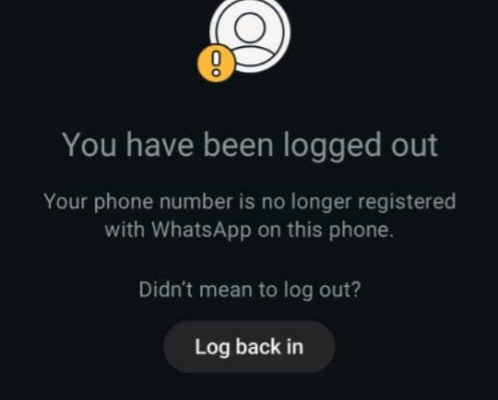
A major wave of WhatsApp account takeovers and scams is currently sweeping across Zimbabwe, prompting urgent warnings from both the Zimbabwe Republic Police (ZRP) and Econet Wireless as well as cyber security experts.
Social media has been awash with affected users saying they have been logged out despite retaining their SIM cards, while some claim they had enabled two-step verification and email recovery but still loose their accounts.
Screenshots circulating online show the message:
“You have been logged out. Your phone number is no longer registered with WhatsApp on this phone.”
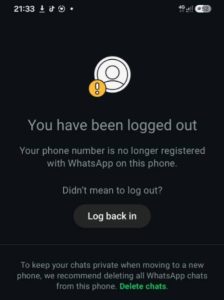
The cause of the reported incidents remains unclear, and it has not been established whether all cases are connected.
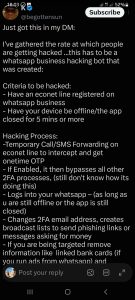
Digital Expert Kuda Musasiwa writing on X said that the recent wave of WhatsApp hacking have been primarily on whatsapp business with a hacking bot that was created
He outlined a familiar pattern that a lot of people falling victim to .
He said “criteria to be hacked:
– Have an econet line registered on whatsapp business
– Have your device be offline/the app closed for 5 mins or more
Hacking Process:
-Temporary Call/SMS Forwarding on econet line to intercept and get onetime OTP
– If Enabled, it then bypasses all other 2FA processes, (still don’t know how its doing this)
– Logs into your whatsapp – (as long as u are still offline or the app is still closed)
– Changes 2FA email address, creates broadcast lists to send phishing links or messages asking for money
– If you are being targeted remove information like linked bank cards (if you run ads from whatsapp) and remove linked accounts like Instagram or facebook.
However, cybersecurity experts who spoke to TechnoMag have highlighted several methods criminals can use to hijack WhatsApp accounts, including social engineering and the unauthorised linking of devices.
Prominent cybersecurity expert and digital forensics specialist Dr Whisper Rukanda said the incidents should be treated as a serious digital identity and financial fraud concern.
“What we are potentially seeing is the exploitation of trust. Criminals may not need to break WhatsApp’s encryption or penetrate its servers. They can manipulate users into surrendering verification codes, exploit weaknesses in SIM replacement procedures, deceive users into linking unauthorised devices, or compromise their phones,” he said.
In an exclusive interview with TechnoMag, Dr Shakemore Chinofunga, an ICT governance and cybersecurity expert, identified linked-device abuse as one method through which criminals can gain access to WhatsApp Business accounts.
He said victims may be tricked into scanning malicious QR codes or entering pairing codes, unknowingly authorising an attacker’s device. Criminals can then access customer conversations and impersonate businesses to solicit fraudulent payments, sometimes without the account owner immediately noticing.
Dr Kundai Chinyongo also warned users against joining suspicious WhatsApp groups and clicking unverified links.
He highlighted a technique known as GhostPairing, in which victims are deceived into linking an unauthorised device to their accounts.
Meanwhile, Econet Wireless, has urged customers to strengthen their WhatsApp security by enabling passkeys and two-step verification.
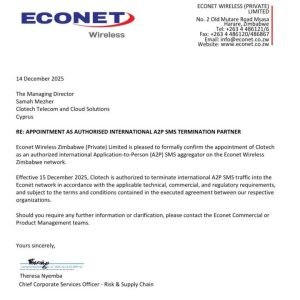
The telecommunications company also cautioned users against sharing verification codes and security PINs, warning that these precautions can help reduce the risk of account hijacking.
Dr Rukanda also said public awareness must be accompanied by stronger identity verification, secure account-recovery processes and rapid incident reporting. He urged users to protect verification codes, review linked devices and independently verify requests for money.
“The broader lesson is that cybersecurity is no longer just about protecting computers and networks. It is also about protecting our digital identities, our businesses and the trust on which our digital economy depends,” he said.












Comments