

 By
By 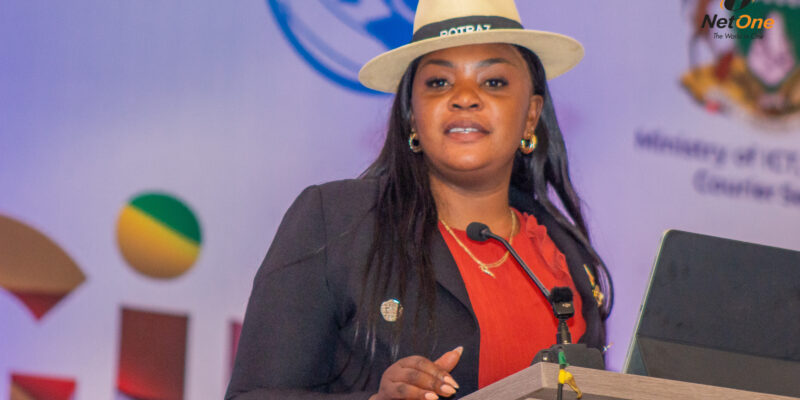
ICT Minister Tatenda Mavetera declared that “the future is being coded today” as she called on girls to take centre stage in Zimbabwe’s digital transformation during the 2026 International Girls in ICT Day commemoration.
Zimbabwe’s commemoration of International Girls in ICT Day 2026 at the National University of Science and Technology was framed as more than a ceremonial event. Minister of ICT, Postal and Courier Services Tatenda Mavetera described it as a national call to action, urging young women to embrace careers in artificial intelligence, robotics, data science, and cybersecurity.
“Our answer as Zimbabwe must be unequivocal: our girls must be at the centre of that transformation,” Mavetera said, stressing that innovation must not reproduce inequality but serve as an equaliser.
The Minister highlighted the National Artificial Intelligence Strategy 2026–2030, launched under President Emmerson Mnangagwa, as a roadmap for modernisation. The strategy positions AI as a driver of growth in agriculture, healthcare, education, mining, finance, and governance.
For the girl child, Mavetera said, the policy opens doors to careers in machine learning, robotics, AI ethics, digital entrepreneurship, and cybersecurity. “Innovation is no longer confined to Silicon Valley. It can emerge from Bulawayo, Gweru, Mutare, Masvingo, Lupane or Murehwa,” she added.
She also praised the SheTech Initiative, led by First Lady Auxillia Mnangagwa, for inspiring girls to pursue STEM careers, alongside partnerships with FAWEZI, UN Women, and the Mastercard Foundation that have provided laptops and mentorship opportunities.
Zimbabwe is investing in digital infrastructure through the Smart Zimbabwe 2030 Master Plan and the High Performance Computing Centre. Education reforms will embed STEM, coding, and data literacy from primary to tertiary levels, with AI Centres of Excellence planned nationwide.
Mavetera spoke personally about overcoming stereotypes in technology. “I know the weight of being told technology is ‘not for girls.’ And I am here to tell you that weight is a lie and together, we are throwing it off,” she said.
She warned of risks in the digital space, including cyberbullying, identity theft, and misinformation. “Technology should empower you, not endanger you,” she said, urging girls to protect personal information and practice responsible online behaviour.
Despite progress, many girls still face barriers such as limited connectivity, harmful stereotypes, and lack of mentorship. Mavetera insisted that girls belong in laboratories, coding academies, innovation hubs, and AI research centres.
“Zimbabwe needs female software developers, cybersecurity experts, data scientists, robotics engineers, and tech entrepreneurs,” she said.
“Most importantly, Zimbabwe needs confident young women prepared to solve African challenges using African solutions powered by technology.”
Closing her keynote, Mavetera urged the audience to transform the commemoration into a movement. “When you learn to code, you are not just writing lines you are writing liberation. When you build AI, you are building bridges out of poverty, bridges into possibility,” she said.
She echoed President Mnangagwa’s call for “techno-preneurs” to push creative boundaries, reminding participants that “nyika inovakwa, inotongwa, inonamatirwa nevene vayo” , a nation is built, governed, and prayed for by its own people.
The event concluded with the official declaration of Zimbabwe’s 2026 International Girls in ICT Day commemoration, marking a milestone in the country’s push for inclusive digital transformation.












Comments