

 By
By 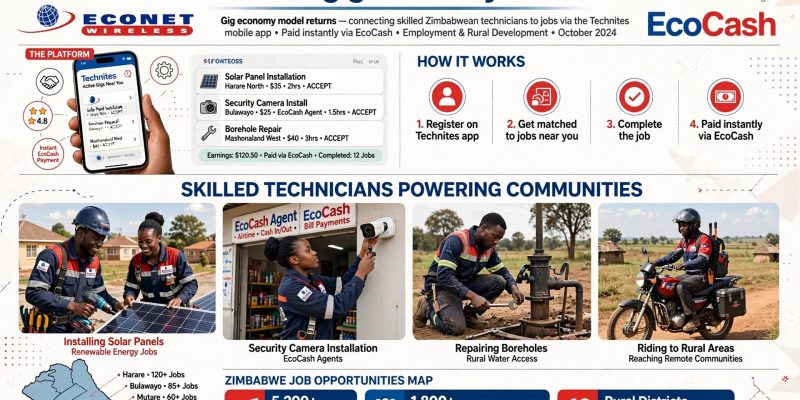
By Ross Moyo
Econet Wireless Zimbabwe has revived one of its most ambitious job creation ideas, bringing back ‘Technites’, a digital platform for independent contractors that connects skilled artisans with paid work, as the country battles chronic unemployment and a growing returnee workforce from South Africa.
The move marks a strategic pivot for Econet from being just a telecommunications and fintech giant to being a direct enabler of self-employment at scale. The company confirmed that work is already underway to register and train the first cohort of Technites who will take on projects for Econet and its subsidiaries, and also be able to offer their services to other businesses and individuals.
Former Econet senior executive Zac Wazara has been tapped to lead Technites as a separate business in which he will be a shareholder, a structure Econet says is designed to make the entity agile, entrepreneurial and independent from the corporate bureaucracy of the main group.
The platform’s first major assignment will be to install 20,000 cameras at EcoCash agent locations countrywide to meet Reserve Bank of Zimbabwe requirements. Many agents operate in rural growth points, townships and farming areas, so the project alone will create jobs across all 10 provinces. Econet said the equipment has already been imported and preparations to train the Technites have begun.
This is not just about cameras.
The technicians will also be trained to install solar panels and repair boreholes, two services that are now critical survival infrastructure in Zimbabwe amid rolling power cuts and water shortages. Econet plans to equip them with motorcycles so they can reach customers, including those in remote rural areas where service delivery has traditionally been poor.
Technites will also take over the installation of solar panels and WiFi at clinics and schools, work that Econet has carried out directly for several years under its higherlife foundation and corporate social responsibility programmes. By outsourcing this to Technites, Econet is formalizing what was previously charity into a sustainable income stream for young technicians.
The concept of Technites follows what has come to be known globally as the gig economy, a model popularized by platforms like Uber, Upwork and TaskRabbit. The artisans work for themselves, not for Econet, while Econet provides the platform to connect them with customers who can pay through EcoCash.
It is a powerful alignment. Zimbabwe has one of the highest mobile money penetration rates in Africa, with EcoCash controlling over 90 percent of the mobile money market. By integrating job matching with instant payment, Econet solves the two biggest problems for informal workers: finding customers and getting paid.
Econet plans to eventually register skilled workers from a wider range of industries beyond electricians and solar installers to include plumbers, builders, carpenters, painters, mechanics and digital technicians. In effect, it wants to become the Amazon for skilled manual labour in Zimbabwe.
“We are eyeing people who have returned from South Africa, as we know many of them are skilled. All they need is support to get back on their feet,” said Econet Wireless Zimbabwe group chief executive Dr Douglas Mboweni.
That comment touches a sensitive national issue. An estimated 1.5 million Zimbabweans live in South Africa, and thousands have returned in recent months due to permit challenges and xenophobic attacks. Many of them are highly skilled artisans — electricians, welders, tilers, solar technicians — who acquired skills in South Africa’s construction and mining sectors but lack capital and networks back home. Technites is designed to absorb them.
Dr Mboweni said Econet also plans to work with the government to use Technites to train young people.
“Econet is a partner in development, and we always try to support the government in addressing economic challenges and so we are responding to its call,” he said.
The timing is critical. Zimbabwe’s formal unemployment rate hovers above 80 percent when using the expanded definition, and youth unemployment is even higher. The government has been pushing private sector-led solutions through its National Development Strategy 1. Econet’s move directly answers that call.
Economists say the gig model could be transformative if done right. Unlike traditional employment where a company must carry permanent salaries, the Technites model allows work to scale with demand. A young person in Mutare can be certified, get a motorcycle, and start earning next week installing cameras in Chipinge, solar at a clinic in Chimanimani, and a borehole repair in Buhera, all booked via phone and paid via EcoCash.
Econet said it will approach other large companies to identify work they could offer through the platform, creating further opportunities for Technites to earn an income. For example, banks needing ATM camera maintenance, retailers needing solar backup, NGOs needing rural installations, and municipalities needing borehole servicing could all post jobs on the Technites platform.
This is the second time Econet has attempted the Technites vision. The original idea was mooted around 2016 but stalled due to economic challenges and foreign currency shortages that made importing kits difficult. This time, the company says the environment is different: local assembly capacity has improved, EcoCash interoperability is stronger, and the demand for off-grid solutions has exploded.
If successful, Technites could become Zimbabwe’s largest private employer without employing anyone directly, similar to how Econet created over 50,000 EcoCash agents who are not staff but earn a living through the platform.
The rollout will begin with intensive training and certification to ensure quality control, a lesson Econet learned from its solar projects where poor installation led to system failures. The company said the first batch will be deployed within weeks to start the 20,000-camera project.
For a country where a job is often the difference between staying and leaving, the return of Technites is more than a corporate announcement. It is a potential lifeline.











Comments