

 By
By 
*By  Ross Moyo*
Forbes has declared Elon Musk the world’s first trillionaire after SpaceX’s Nasdaq debut pushed his net worth to an estimated $1.1 trillion Friday morning.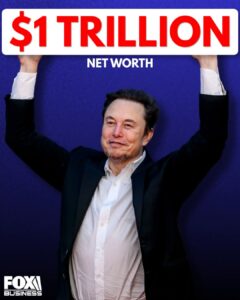 SpaceX began trading at $150 per share, valuing the company at nearly $2 trillion market cap. The IPO priced Thursday at $135 per share, lifting Musk’s fortune by $188 billion to $982 billion overnight before Friday’s surge.
Musk’s wealth is now a full-stack bet on orbital infrastructure and artificial intelligence. As SpaceX chairman, CEO and CTO, he owns 4.8 billion shares worth $715 billion and 350 million stock options worth $50 billion — a 38% stake. The valuation reflects markets pricing SpaceX not just as a rocket company, but as the compute + connectivity layer for space: reusable Starship launch, Starlink’s LEO constellation, and data-driven flight optimization.
The trillionaire threshold signals how wealth is compounding at the intersection of hardware, software and networks. Forbes’ Matt Durot said: “Elon Musk’s ascent to a $1 trillion fortune represents a milestone once considered unimaginable, highlighting how rapidly wealth can be created in an increasingly interconnected and technology-driven world.” 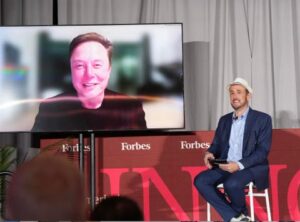 SpaceX’s IPO is being read as the “cloud infrastructure moment” for space, where cost-per-kilogram to orbit and satellite bandwidth become recurring revenue streams.
Musk’s trajectory shows exponential tech compounding. He debuted on Forbes’ Billionaires list in 2012 at $2 billion, ranked 634th globally. Nine years later he passed Bezos as world’s richest in January 2021 on Tesla’s vertical integration and software margins. Now SpaceX adds orbital economics to that stack, with Starlink scaling to enterprise clients and Starship reducing launch costs through reusability.
Forbes Chief Content Officer Randall Lane called the brand the benchmark for wealth measurement: “No other media brand combines the same depth of historical wealth data, editorial credibility, and global reach.” The data repository tracks how tech founders convert R&D risk into network-effect assets — exactly Musk’s playbook from Tesla batteries to SpaceX engines to AI training clusters.
At the Forbes Innovator 250 Celebration in Palo Alto, Musk previewed the next 5-year inflection. “In five years, digital intelligence will exceed the sum of all human intelligence. In five years, there might be at least 100 million humanoid robots, but maybe a billion,” he said. “I predict the economy is probably twice its current size in five, maybe six, years.” The forecast ties SpaceX’s orbital data, Tesla’s energy grid, and xAI’s models into one exponential curve.
The $75 billion IPO gives SpaceX capital to scale Starship production, expand Starlink ground stations, and integrate AI into autonomous launch and satellite operations. For thousands of employees holding equity, code commits and rocket tests convert into generational wealth as technical milestones hit the public markets.
Forbes has tracked wealth for 40+ years since the first Billionaires List in 1987. Musk becoming trillionaire #1 redefines that dataset: the next fortunes will be built where AI, robotics and space infrastructure converge. “Today marks a new chapter in the evolution of global business and entrepreneurship,” Durot added.
The headline number is $1.1 trillion. The underlying story is convergence. Musk’s portfolio spans electric energy, satellite broadband, reusable rockets and frontier AI — all feeding data and cash flow into each other. Markets are pricing that flywheel, not just individual companies.










Comments